Showing posts with label winning. Show all posts

Wednesday, July 11, 2012

Stand Out with Memorable Scripture


Some Bible verses come up almost every speech in a round, depending on the category and region. Soon the speeches all start to sound alike (especially in Category IV). Most of us memorized these familiar passages in AWANA or Sunday School, and you know your judges have heard them before. 

Nothing is wrong with these verses; they're just overused. Standing out from the competition is crucial to moving up in the ranks, so why use the same scripture as everyone else? At the same time, you have to support your points with Biblical evidence. 

I invite you to get creative with what Bible passages you cite, and I’ve made a list to get you started. I haven’t included the verse texts because it’s up to you what version you wish to use.

Category IV


Instead of John 3:16 and Romans 6:23, try 1 John 4:9-10.

Instead of Ephesians 2:8-9, try Galatians 2:16, Titus 3:5 (or verses 3-7 in context), or 2 Timothy 1:9-10.

Instead of Romans 5:8, try 1 Peter 3:18.

Also consider Galatians 4:3-5 and Acts 10:38-43.

Category V


Instead of John 14:6, try 1 John 5:11-12 and 20.

Also consider 1 Corinthians 1:30 and Hebrews 2:14 & 17.

Category II


Instead of 2 Timothy 3:16, try Proverbs 30:6.

Also consider Isaiah 45:19 and Numbers 23:19.

Category III


Instead of Romans 3:23, try Romans 5:12, Psalms 14:2-3, or Ecclesiastes 7:20.

Is there another overused verse in your region that you think should be substituted? Found a helpful passage you’d like to share? Post a comment!

Thursday, June 21, 2012

4-Point Refutation in Apologetics


When starting out, it's easy to fill a speech with assertions, conclusions, and support willy-nilly. Things get more complicated when you address claims you don't believe. However, there is an orderly way to refute an idea with which you disagree. Debaters should recognize this format, and even non-debaters will find it simple to understand and use.

Point 1: Identify. While you won’t hear “Contention 3” or “Disadvantage 24”, most General Questions and Statements hide assumptions that you can expose to the judges. For instance, topic III.B.7, “Why would a loving God create hell?” implies that God must not be loving because condemning anyone to hell is cruel. Identifying the assumption behind the question increases your credibility and clarifies your speech.

Point 2: Tag. A “tag” is a summary of your point, short enough for the judge to quickly write down. Fortunately, writing space on an IE ballot is way bigger than those tiny columns on a debate flow! Still, keep it concise and very clear. A tag might be something like, “Hell is a just punishment for sin,” or “God loves by giving sinners what they want.”

Point 3: Support. Don’t just make claims; give the judges a reason to prefer your point over your opponent’s, even theoretical ones. Debaters are rated on their use of evidence or support, and guess what? So are you! In fact, that’s the first thing the judges rate you on after stating and adhering to the topic. (You can download an NCFCA Apologetics ballot here.) It is crucial to include scripture and outside sources, and even more crucial that your support actually strengthens your claims.

Furthermore, speakers too often neglect to cite sources. If you read a statistic, state the year the study was done and what organization performed the research, at the very least. There’s no rule requiring it, but it shows credibility and academic integrity, as well as helping the audience find the information later to share with unbelievers.

Be specific with quotations. Instead of saying, “the Bible says that,” or “as the apostle Paul wrote,” cite the reference if you can. And instead of “C.S. Lewis once said something like,” try “C.S. Lewis wrote in chapter 5 of Mere Christianity,” and read the quotation verbatim.

You don’t have an opponent across the table now, but be ready to dialogue with the many people who disagree with Christianity. Document your support just as carefully as you would for a debate round.

Point 4: Impact. Impacting is showing why your point matters to the judge. Often overlooked, this step can make your speech more personal and memorable. This is different from explaining the meaning and significance of a term in that it focuses on the significance of a particular point you’ve introduced, not an entire theological concept chosen for you to explain.

If you’ve never used 4-point refutation in apologetics, give it a try! Practice using it in your debate rounds, too, if you don’t already. Whenever you’re refuting an idea, this simple format is a recipe for clarity, organization, and solid communication. 

Tuesday, June 19, 2012

Best Wishes!

Wow! Nationals is finally here! Are you ready?

I'm guessing that if you're competing this week, you probably don't feel ready. That's okay. There's always more you "coulda, woulda, shoulda done" to prepare. Your job now is to go in and give the best speech you can with what you have.

Before you start competing, I invite you to take a moment and consider, What do I want to remember after this week is over? Ask God how you can use the week for His glory. Spend some meaningful time in prayer.

I know it's cliche for me as an alum to tell you to be a great friend and focus on people more than trophies, but we alumni say that because it's true. You can make memories with your friends and meet new people while you aren't competing and still excel when you walk in front of the judges. You can't ignore everyone else to obsess over competition and still expect to make memories worth reminiscing about. (That doesn't mean you can stay out all night partying while you're still in the running or be late for a speech because you get into a fun conversation, of course!)

If you're at Nationals but didn't make it in Apologetics this year, why not take advantage of the opportunity and watch a round or two? Take notes and use what you observe to improve your own speaking.

Even if you're somewhere else this week, you probably have friends and fellow club members competing in various events. Take a moment and pray for them, and send encouraging messages. If you aren't sure what to pray about, think of what you would want someone else to ask God if you were the one competing. I can say from experience that it means a lot to know that the rest of the region back home is supporting you.

Love God, love people, keep priorities straight, and no matter where you are, have a great week!

Tuesday, June 12, 2012

How to Print Index Cards


Why handwrite your apologetics cards when you can just type and print them? Here’s how. 

Pictures were taken with Windows' snipping tool and a Nikon Coolpix S6000 and show Microsoft Office Word 2010, 3x5 cards (no longer permitted for NCFCA competition), and a Lexmark Pinnacle Pro901.

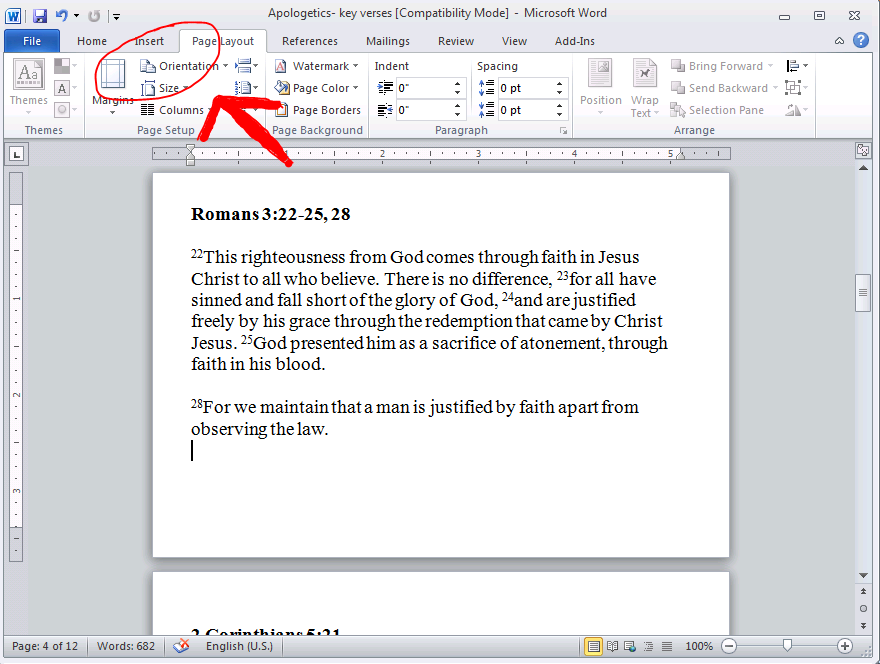
1. Format Your Document. Open Microsoft Word and click on the “Page Layout” tab. Set your paper size to 4x6. Adjust the margins if necessary. If you like, you can also change the orientation from portrait to landscape, turning it sideways. When you’re ready, type the content of your card.


2. Prepare Your Printer. Open your printer’s paper tray and remove any letter-size paper. Place two or three index cards in it, with the narrow ends facing the printer’s paper feed. Look for the adjustable arm in the paper tray and slide it towards the cards until it is just touching them. How this looks will vary among printers; this Lexmark is symmetrical, but other printers may have one arm that slides the cards to one side.


3. Verify Print Settings. When you’re ready to print, make sure that the printer is on the settings you want and that the print preview looks correct. You also might want to print a practice card first; that way you can make sure the alignment is correct and you’re printing on the blank side of the cards instead of the lined side.


4. Print and Enjoy! I assume you aren’t doing this as your parents throw your suitcase in the family homeschool bus and drag you out the door (because none of us have ever waited until minutes before we left for a tournament to print scripts, submission forms, cases and briefs, or anything like that, right?). If that’s the case, this would be a great time to practice the speech(es) you just prepared. Why wait? Grab a Bible and timepiece, and have fun persuading imaginary judges and kicking imaginary competitors’ butts… in a loving, Christian way, of course.  


Found this helpful? Share it with other NCFCA speakers and coaches! 

Tuesday, May 22, 2012

Being a Winner


When you think of winning in apologetics, what comes to mind?

Maybe you’re focused on winning in competition. You have your eyes set on the medals and trophies at the end of the tournament, and you’re dead set on dominating the competition, one round at a time.

Or maybe you’re focused on winning the argument. Whatever ungodly worldview the other person throws out at you, you know your stuff and can shoot it down, leaving that heathen floundering for a response.

Trophies and good arguments are great, but (you guessed it) the attitudes I’ve just described are obviously wrong. Consider what the Bible says about winning:

The fruit of the righteous is a tree of life, and he who wins souls is wise. (Proverbs 11:30, NIV1984)
When we do apologetics, it’s easy to focus on the wrong type of winning. Think about it: how much effort do you put into winning souls to God? Trophies will collect dust, rankings will be forgotten, and even knowledge will pass away. Souls last forever.

Always remember, the point of speaking truth is to persuade another person—a valuable human precious to God and made in His image—not just to be right! Make the most of each opportunity to speak the truth.

Be wise: win souls, and you’ll always be a winner!

Since, then, we know what it is to fear the Lord, we try to persuade men… For Christ’s love compels us…  So from now on we regard no one from a worldly point of view. Though we once regarded Christ in this way, we do so no longer. Therefore, if anyone is in Christ, he is a new creation; the old has gone, the new has come! All this is from God, who reconciled us to himself through Christ and gave us the ministry of reconciliation: that God was reconciling the world to himself in Christ, not counting men’s sins against them.
 And he has committed to us the message of reconciliation. We are therefore Christ’s ambassadors, as though God were making his appeal through us.
 We implore you on Christ’s behalf: Be reconciled to God. (2 Corinthians 5:11, 14, 16-20)